Sourcing paw patrol bubbles wholesale requires more than finding the lowest quoted price. Buyers must balance character licensing, product safety, packaging quality, and seasonal demand. The opportunity is real. Licensing International’s 2024 Global Licensing Industry Study valued licensed merchandise and services at approximately $356.5 billion in 2023. Entertainment and character properties remained major contributors. This supports careful evaluation of branded children’s products.
The product itself looks simple. A small bottle, colorful liquid, and a familiar character can attract families quickly. However, weak seals may leak inside cartons, while unclear labeling can delay retail approval. Suppliers should provide business credentials, authorization evidence, test reports, ingredient information, and production photographs. Relevant requirements may include ASTM F963 in the United States and EN71 standards in European markets. Requirements differ by destination.
Start with the target market.
Request samples before discussing large quantities. Check the cap, wand, label adhesion, liquid clarity, carton strength, and odor. Ask whether the supplier controls production or outsources it. That detail matters. In my view, many sourcing mistakes begin with attractive photographs and incomplete documentation. A low unit price can become expensive after damaged goods, relabeling, or missed delivery windows.
Circana’s toy industry reporting has repeatedly shown that consumer demand shifts by category, price point, and season. Therefore, buyers should compare MOQ, landed cost, replenishment speed, and holiday timelines. This guide explains how to screen factories, verify paw patrol bubbles, negotiate responsibly, and build a practical wholesale order. It also considers a difficult question: when does a cheaper quote signal efficiency, and when does it signal hidden risk?
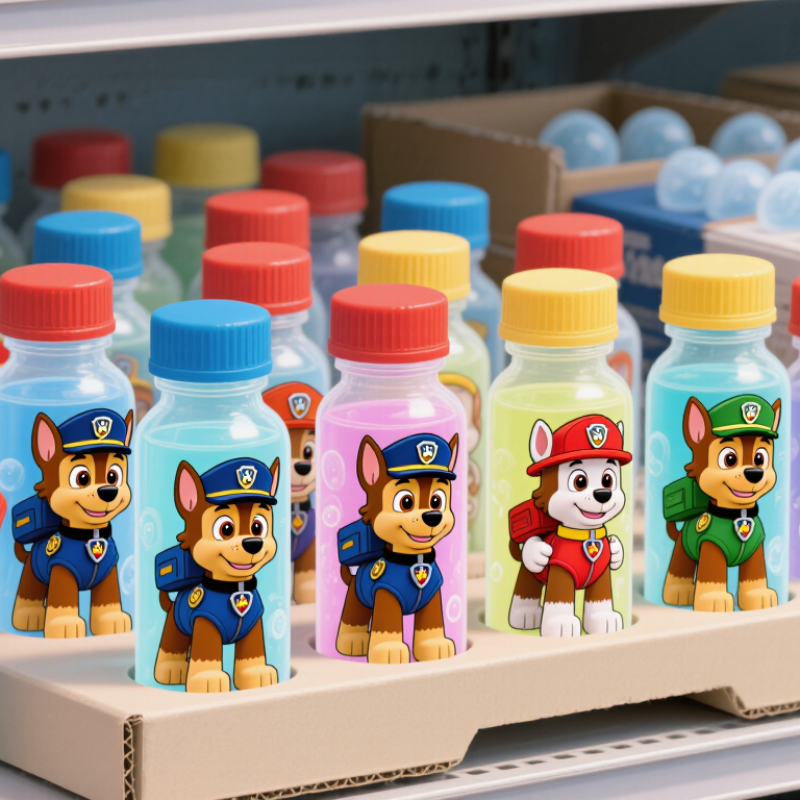
Define your wholesale requirements before contacting suppliers. Specify bottle size, pack count, target age, artwork area, and preferred delivery window. For character-themed bubble products, confirm the licensed artwork and approved packaging process. Do not leave this vague.
Market data supports careful planning. Grand View Research estimated the global toys market at USD 108.7 billion in 2023, with growth expected through 2030. Licensing International reported USD 356.5 billion in global licensed merchandise and services sales in 2023. These figures show strong demand, but they do not guarantee fast sales for every bubble format. Your order quantity should match store traffic, seasonal promotions, and available shelf space. A 24-bottle case may suit small retailers, while larger chains may need mixed pallets.
Ask suppliers for a complete specification sheet. It should list liquid ingredients, fill volume, bottle material, carton dimensions, batch coding, and leakage-test results. Request samples from the actual production line, not only a showroom sample. Check cap strength, bubble output, label adhesion, and staining on cotton fabric. Products should meet applicable toy-safety requirements, such as ASTM F963 or EN 71, depending on the destination market. I would also request third-party laboratory reports, although paperwork can still miss a weak cap or inconsistent fill. That practical gap deserves attention. Define acceptable defect rates, inspection timing, replacement terms, and shipping responsibilities in writing.
Sourcing Paw Patrol bubbles wholesale requires more than comparing carton prices. Start with licensing verification. Ask the supplier for written authorization, the license holder’s legal identity, territory, sales channel, and validity dates. Match those details against official trademark records and commercial invoices. A genuine product should have consistent artwork, manufacturer information, batch codes, and traceable packaging. Blurry printing is a warning sign.
Safety checks should be documented before purchase. Request laboratory reports for liquid ingredients, container materials, and packaging. For United States sales, confirm testing against ASTM F963-23 and applicable Consumer Product Safety Improvement Act requirements. European shipments may require EN 71 documentation. Check age grading, warnings, tamper seals, and chemical disclosures.
The U.S. Consumer Product Safety Commission reported an estimated 231,000 toy-related emergency department injuries in 2023. Small packaging defects can become serious problems.
Inspect samples yourself. Shake each bottle, examine the cap seal, and test the wand for sharp edges. Compare ten units from different cartons, not just one attractive sample. I would also request a recent certificate, not a recycled PDF. My weak point is trusting polished paperwork too quickly. Documents can look professional and still lack batch relevance. A practical purchase file should include supplier registration, authorization letters, test reports, inspection photographs, and shipment records. Keep samples from every production lot. That makes complaints easier to investigate and helps separate an authentic product from a copied one.
How to Source Paw Patrol Bubbles Wholesale?
Finding a qualified wholesale supplier requires more than comparing the lowest price. Start with suppliers experienced in children’s outdoor toys and liquid bubble products. Request a current product catalog, business registration details, factory photos, and export references. A reliable supplier should explain materials, packaging, minimum order quantities, and production schedules clearly.
Ask for samples before placing a bulk order. Check the bottle seal, wand shape, liquid clarity, scent, and label accuracy. The packaging should survive stacking and transport without leaking. Request safety test reports and ingredient information for your target market. Compare at least three suppliers using the same checklist. This makes pricing differences easier to understand. I once focused too much on unit cost and overlooked weak cartons. That mistake created avoidable shipping damage.
Tips: Confirm whether sample fees are refundable. Ask for a written quotation with product, packaging, shipping, and payment terms. Check response speed and technical knowledge. A supplier that avoids direct questions may create problems later. Review production photos carefully, but do not treat photos as proof. An independent inspection can verify quantity, packaging, and visible defects before shipment. Also compare lead times during busy seasons. A cheaper supplier may not be the best supplier if delivery dates remain uncertain.
| Sourcing Channel | Best Use Case | Typical MOQ | Typical Lead Time | Customization | Compliance Documents to Request | Main Evaluation Point |
|---|---|---|---|---|---|---|
| Authorized licensing distributor | Resellers needing officially licensed character merchandise | Usually low to medium case quantities | About 3–15 business days when in stock | Usually limited to approved packaging or assortment options | License authorization, product safety reports, batch information, packaging artwork approval | Proof that the seller is permitted to distribute the licensed product |
| Specialized toy manufacturer | Large-volume orders and private-label bubble products | Commonly 1,000–10,000 units, depending on packaging | About 30–60 days after artwork and sample approval | Bottle shape, colors, labels, carton configuration and fragrance options may be available | Applicable toy testing reports, chemical safety documents, factory quality records and batch traceability | Production consistency, quality-control process and minimum order economics |
| General merchandise wholesaler | Retailers testing demand with mixed toy assortments | Often 1–10 cartons or mixed-case quantities | About 2–10 business days for available stock | Generally not available; stock is usually prepacked | Product test report, ingredient or material declaration, country-of-origin details and carton specifications | Stock accuracy, assortment suitability and delivered unit cost |
| B2B sourcing marketplace | Comparing multiple factories and requesting competitive quotations | Frequently 500–5,000 units, but seller terms vary | About 25–60 days for made-to-order goods | Often available for labels, cartons, colors and pack quantities | Independent laboratory report, factory audit evidence, material declaration and inspection records | Supplier verification, sample quality and protection of payment terms |
| Import agent or buying office | Buyers needing factory communication, inspection and shipping coordination | Usually medium to large commercial orders | About 35–75 days including production and freight preparation | Can coordinate packaging and product adjustments with the factory | Supplier audit, pre-shipment inspection, laboratory testing, shipping documents and customs data | Transparent service fees, inspection scope and ownership of compliance records |
| Domestic cash-and-carry wholesaler | Urgent replenishment and small trial orders | Often one case or less, subject to local policy | Same day to 5 business days | Not normally available | Commercial invoice, product labeling, safety documentation and traceability information | Immediate availability, local regulatory fit and return policy |
Wholesale sourcing starts with a realistic comparison of pricing, minimum orders, and shipping terms. A low unit price can hide expensive freight, packaging, or inspection charges. Ask suppliers for a complete quotation based on bottle size, liquid volume, carton quantity, and printed packaging. Request prices at several quantities, such as 500, 2,000, and 5,000 units. This reveals whether the discount is genuine.
Minimum order quantities deserve careful attention. A supplier may require 1,000 pieces per color or 3,000 pieces per design. That can create excess stock if demand is uncertain. I once focused too heavily on the unit price and underestimated warehouse space. It was an avoidable mistake. Ask whether mixed cartons are allowed, and confirm sample costs before placing a production order. Check product materials, age guidance, and safety documentation through qualified testing channels.
Shipping terms can change the final cost significantly. Compare EXW, FOB, and DDP quotations carefully, because each includes different responsibilities. Confirm the production lead time, port, carton dimensions, gross weight, and estimated transit time. Request shipping options by sea, rail, or air when timing matters. Clarify who handles customs paperwork and destination charges. Get everything in writing. Small details matter. A supplier’s promise of “fast delivery” means little without a specific dispatch date and agreed remedy for delays.
Place the order around demand, not excitement. Circana reported that U.S. toy sales fell 8% in 2023, reaching $28.6 billion. That decline makes careful forecasting essential. Review school holidays, weather, and retailer promotions before choosing your quantity. Request a written quotation showing unit price, minimum order quantity, carton size, shipping terms, and production time. Keep the artwork approval separate from the purchase order.
Inspect samples before paying the balance. Check bubble volume, cap strength, leakage, print alignment, and surface finish. Test several units after shaking and storing them in warm conditions. Ask for current laboratory documentation covering applicable toy-safety requirements, age grading, chemical limits, and labeling.
The U.S. Consumer Product Safety Commission states that children’s products require third-party testing and certification when relevant rules apply.
Documents matter. Physical checks matter more.
Manage the shipment with a simple inspection sheet. Record lot numbers, sample quantities, defects, photographs, and corrective actions. AQL sampling can support consistency, but it cannot replace product judgment.
The International Trade Centre highlights packaging and delivery reliability as important factors in cross-border trade performance. Confirm carton drop protection and count every carton at arrival.
I once focused too heavily on colorful packaging and missed weak caps. That was avoidable. Leave a small buffer for delays, rework, and seasonal demand. My forecast may still be wrong. Review sales weekly and reorder only after quality remains stable.